Article
Mar 25, 2026
The New Intelligence Stack: How Top Operators Use Multi-AI Strategy to Make Better Business Decisions
Learn how multi-AI decision-making improves business strategy by combining logic, pattern recognition, and intuition for faster execution.

Why Most Business Decisions Are Still Broken
In today’s business landscape, leaders have more data, more tools, and more “answers” than ever before.
Yet decision-making hasn’t improved at the same rate.
Why?
Because most businesses are still operating at a surface level, relying on a single perspective, a single tool, or a single assumption.
At Dabella Consulting, LLC, we see this every day. Founders and operators are not lacking information. They’re lacking structured intelligence.
The problem isn’t access to answers.
It’s the inability to synthesize truth across multiple inputs and execute with clarity.
TL;DR: Smarter Decisions, Faster Execution
Most businesses don’t fail from lack of information, they fail from poor decision frameworks.
Using a single AI or perspective creates blind spots.
Top operators use multi-AI synthesis combined with:
•̇ logic
•̇ pattern recognition
•̇ intuition
The advantage is not more data, it’s better filtering and faster execution.
👉 Book a strategic consultation to implement this in your business
What Is a Multi-AI Decision Framework?
The next evolution of decision-making is not choosing the “best” AI.
It’s orchestrating multiple systems, perspectives, and disciplines into a unified strategy.
This means:
•̇ comparing outputs
•̇ identifying contradictions
•̇ pressure testing assumptions
•̇ synthesizing a final decision
This is how modern operators think.
Why One AI Model Isn’t Enough
No single system is perfect.
Each model has strengths:
•̇ creativity
•̇ logic
•̇ technical depth
•̇ execution
Relying on one creates blind spots.
Truth emerges from friction between perspectives, not agreement.
The Three-Layer Decision System
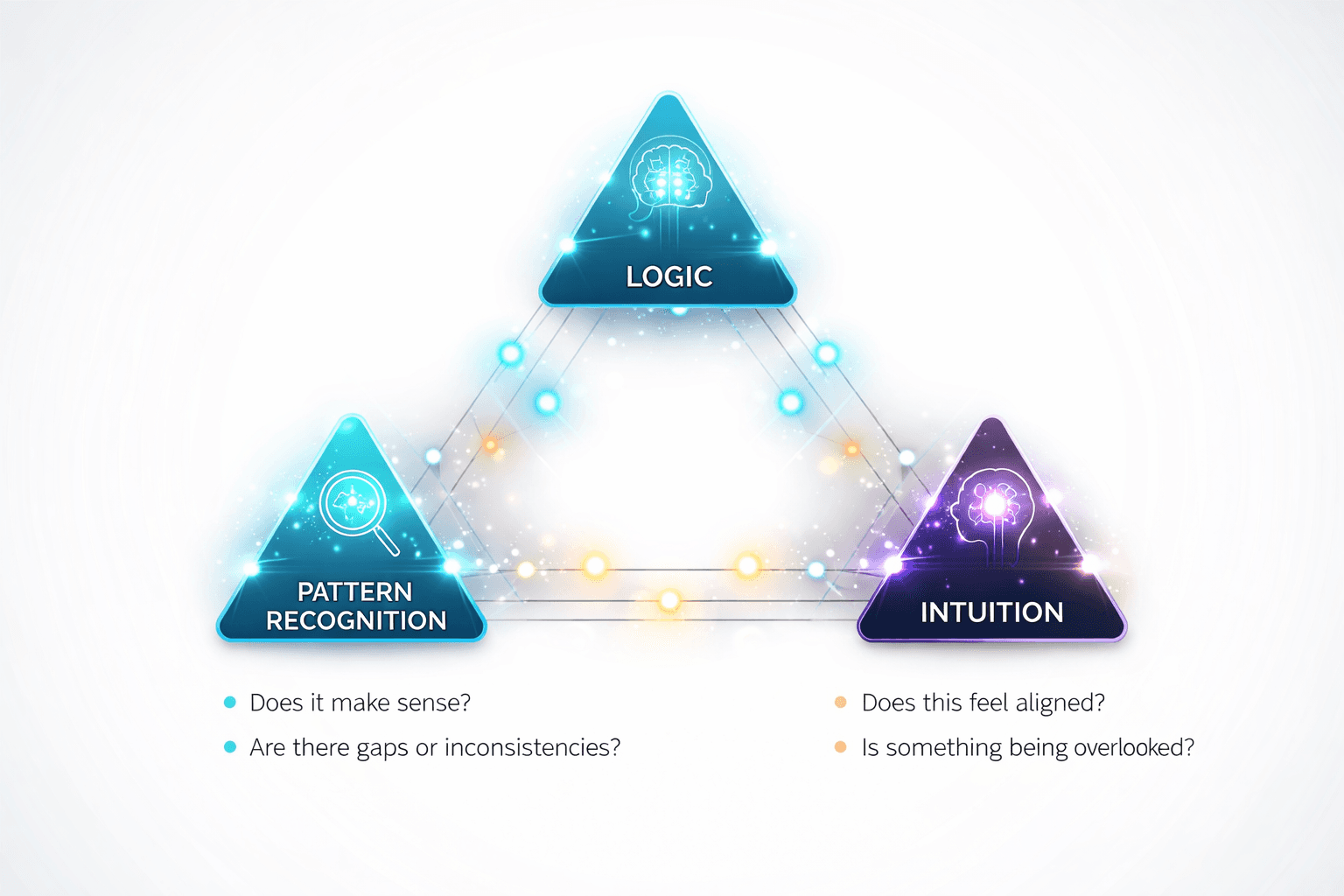
“The three-layer decision framework used by high-level operators”
High-level operators consistently rely on three filters:
1. Logic
Does it make sense?
Are there gaps or inconsistencies?
2. Pattern Recognition
Have I seen this before?
What worked and what failed?
3. Intuition
Does this feel aligned?
Is something being overlooked?
Key Insight
When all three align, execution becomes clear.
When one is off, deeper analysis is required.
👉 See how our Fractional CxO model applies this to your business
The Hidden Risk of Overthinking
More inputs don’t always mean better decisions.
Without structure, it creates:
•̇ analysis paralysis
•̇ conflicting conclusions
•̇ false confidence
The solution is not more information.
It’s better filtering and faster execution.
Real-World Example: When AI Disagrees
We recently pressure tested multiple AI systems against each other while evaluating a new application.
Each system gave different answers.
Each sounded correct.
But they contradicted each other.
Instead of choosing one, we challenged both, identified blind spots, and synthesized a better outcome.
👉 Read the full AI vs AI decision-making case study
The Fractional CxO Advantage
Most businesses get stuck between insight and execution.
At Dabella Consulting, we bridge that gap.
We:
•̇ structure decision frameworks
•̇ eliminate noise
•̇ align strategy with execution
•̇ drive measurable outcomes
👉 Explore our Fractional CxO process
From Information to Execution: A Repeatable System
•̇ Gather inputs
•̇ Create tension
•̇ Apply logic, pattern, intuition
•̇ Decide and execute
•̇ Refine based on results
Final Thought
The competitive edge is not in having more information.
It’s in:
•̇ thinking clearly
•̇ deciding confidently
•̇ executing quickly

“From uncertainty to clarity, this is the shift.”
Ready to Upgrade Your Decision-Making?
👉 Schedule a Strategy Call
👉 Get a Custom Execution Plan
About the Author
Bryan is a strategic hybrid advisor and fractional C‑suite partner who’s spent the last two decades reverse‑engineering companies from the inside out, from lending and financial services to founder‑led startups and growth‑stage businesses. He’s seen “bad leads” blamed for what was really broken communication, slow response, and weak systems, and has helped owners dramatically improve bookings simply by tightening basics like professional email identity, speed‑to‑lead, and follow‑up. When he talks about closing execution gaps, it’s from lived experience, not theory.